

Ultra-Fast Stochastic Pit Optimizer
GeoMine’s FlowPit is an ultra-fast stochastic pit optimization module. FlowPit implements the pseudo-flow algorithm (equivalent to, but much faster than, the industry standard Lerchs-Grossmann’s 3D pit optimization algorithm). FlowPit’s highly efficient and scalable implementation achieves a superior magnitude speed-up compared to competitors. For small block models (with about 1 million non-air blocks), FlowPit takes seconds to complete a single optimization run. For large block models (with >50 million non-air blocks), FlowPit takes full advantage of today’s multi-core CPUs to determine the optimum final pit limit.
To arrive at a solution in a realistic time frame for large block models, most existing mine planning software for open pit mining (pit optimizers) uses super-blocking to reduce total block counts drastically. Consequently, this materially affects the solution accuracy, which has just been quantifiable up to now. Usually, a single careless 2x2x2 reblocking can result in a final pit with up to 7% profit loss and a slight pit slope change (please refer to the Impact of Reblocking on Pit Optimization for a detailed analysis). With FlowPit, mine planners no longer need to super-block their block model and even if they do, they now have a proper tool to evaluate the impact of their chosen reblocking configuration on their block model. This advance in computational speed with guaranteed optimality makes FlowPit an effective tool not just for determining the optimal pit limit but also for Sensitivity Analysis that allows the planner to conduct reliable “what if?” scenario analyses quickly.
FlowPit features a powerful slope modeling sub-module: not only can pit slope angles be varied by sectors and levels, but they also can be varied by both regions and rock types within regions (where other competitors that we know of can only change the pit slope angle by either regions or by rock types, not both).
FlowPit also offers a unique Stochastic Optimization option that accepts a group of block model realizations as input and generates a defensible open-pit reserve distribution as opposed to a single point reserve estimate. This enables mine planners to quantify geological uncertainty and risks inherent in open-pit projects in a single optimization run.
FlowPit Key Benefits
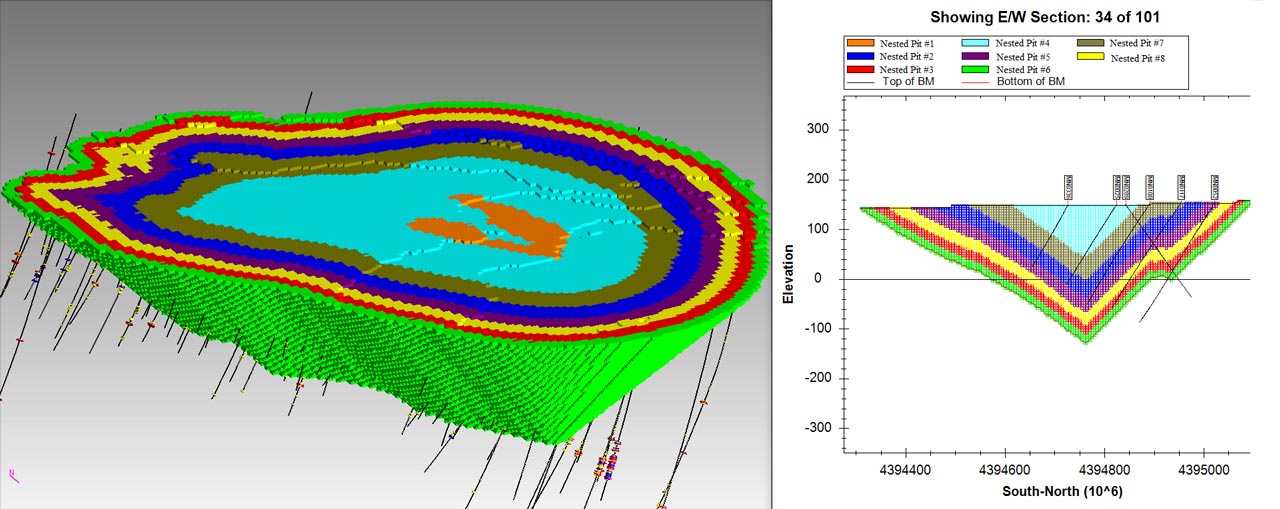
- Power: Features a powerful nested pit generator with a Stochastic Optimization option, and a Sensitivity Analyzer. Includes two options for creating nested pits: LG nested pits for creating LOM schedules (with iScheduler) that maximize NPV and equal-sized geologically optimum pits for creating smooth LOM schedules (with iScheduler) having relatively constant production rates.
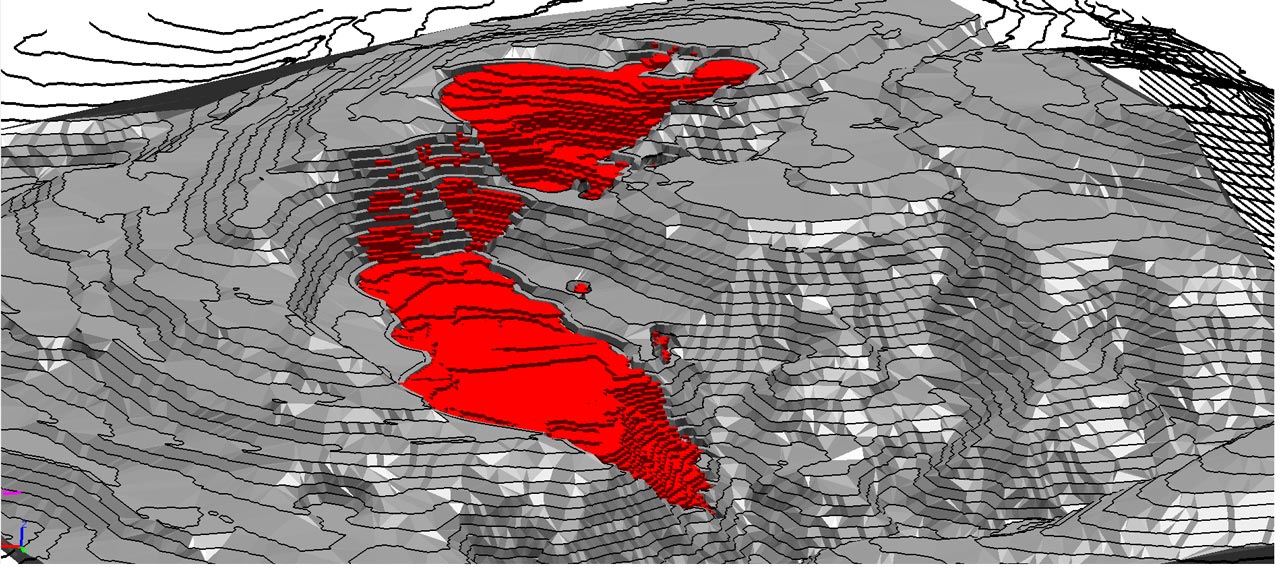
- Unique: Full 3D optimization support for rotated, stratified narrow dipping ore seams to minimize dilution.
- Speed: Easily offers an order of magnitude speed-up over other competing products.
- Scalability: 64-bit parallel version can handle huge block models (with up to 100 million non-air blocks) with precision and accuracy without super-blocking. FlowPit v5 has been successfully used to optimize a real-life block model with over 89 million non-air blocks without super-blocking!
- Simplicity: Intuitive GUI front-end that displays interactive 3D pushbacks, periods, cross sections, and plan views all in one integrated package
- Flexibility: Versatile Slope Modeling, Visual Cell Scripting engine, Report Generator, Slope Geometry Modeler, support for sub-blocks and partial blocks, and the ability to preview, inspect and correct any potential errors of input block models help round the package.
FlowPit Feature List
Generation of Different Types of Nested Pits
Different types of nested pits can be generated to create life-of-mine schedules (with iScheduler) that aim to either maximize NPV or meet the production target (by having more or less equal metal quantity in each nested pit).
Ability to recall optimization settings for all pit optimization runs.
Sensitivity Analysis
Sensitivity analysis allows the user to see the impact of changes to any variable (price, costs) on the project’s profitability, as well as the impact of geological uncertainty.
Stochastic Optimization Option
This option allows a group object consisting of multiple block models to be used as input. It enables mine planners to quantify geological uncertainty and risk inherent in any open pit project in a single optimization run. This option generates a open-pit-able reserve distribution (P10, P50, P90) as opposed to a single reserve estimate.
Block Model Resizing, Preview and Inspection
Expands a geological block model to a full resource block model that is ready for pit optimization (by adding the missing waste blocks).
Shrinks a block model by removing excessive waste blocks w/o sacrificing the solution optimality.
Allows the user to detect and correct potential errors in the input block model before optimization starts.
Powerful Post-Optimisation Visual Report Generator
Allows maximum flexibility in report generation without custom scripting.
Handling Huge Block Models
GeoMine-FlowPit is capable of processing 100mil blocks.
Support for Exclusion Regions
Property lines that must not be crossed can be specified as a 2D polygon or a 3D mesh to confine the optimization process.
Output to CSV Format and to DXF Format
Outputs to CSV format and DXF format.
Exploiting Parallelism on Multi-Core CPUs for Ultimate Performance
Exploiting parallelism on multi-core CPUs for ultimate performance.
Flexible Block Value Formula Editor
Supports multi-minerals, partial/percentage or sub-blocked block models with unlimited user conditions or constraints. FlowPit’s Cell Scripting Engine opens the door to virtually infinite possibilities for mine planners that make a difference.
Variable Slope Angle
Slope angles can vary by region and rock types within the regions, sectors, and/or levels.
Option to Normalize and Reblock
Option to normalize and reblock input block model if needed.
Supports a Large Range of ASCII File Formats
Supports an extensive range of ASCII file formats exported by all General Mining Packages.
System Requirements:
CPU: Quad Core
RAM: 16gb
HARD DRIVE: 500gb SSD
VIDEO CARD: 1gb VRAM
CPU: 3rd Gen Ryzen 5/7 or Intel i7
RAM: 32gb
HARD DRIVE: 1tb SSD
VIDEO CARD: 2gb VRAM